
For businesses preparing their UAE Corporate Tax return, filing is not simply a matter of taking figures from the accounts, entering them into EmaraTax and submitting the return.
The information reported in the return is based on the business’s financial records and the transactions behind those figures. A review of the accounts before filing can therefore be important, particularly where there are adjustments or transactions that require specific Corporate Tax treatment.
For businesses with a financial year ending on 31 December 2025, the deadline to file the Corporate Tax return and pay any Corporate Tax due is 30 September 2026. With the filing deadline approaching, many businesses are now reviewing their financial records and tax position.
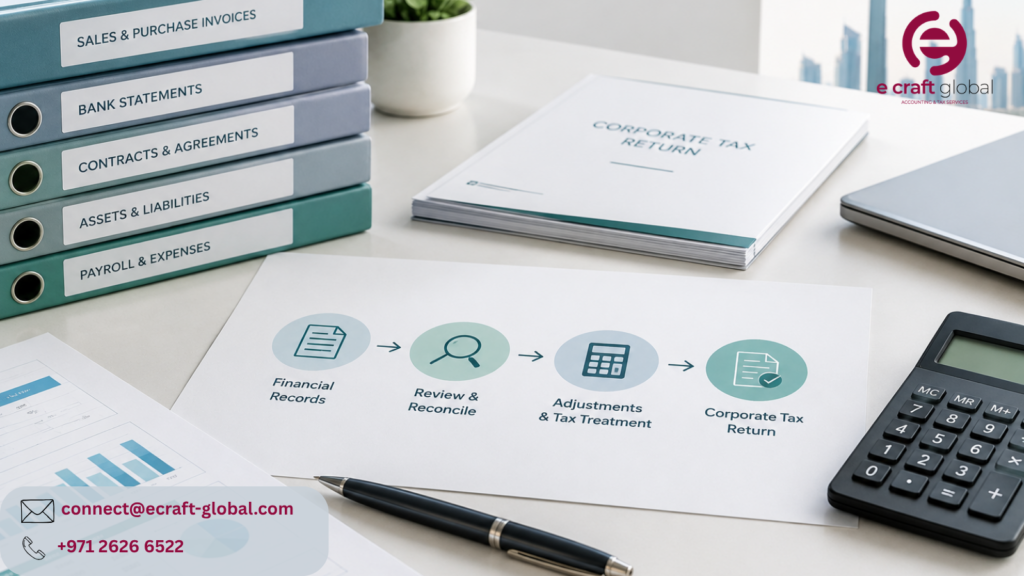
The accounting records are the starting point
The Corporate Tax calculation begins with the accounting profit or loss reported in the financial statements.
This means that the quality of the underlying accounting records has a direct bearing on the tax computation. Unreconciled bank balances, outstanding entries, old receivables or payables, and transactions that have not been properly recorded can all affect the figures used for the Corporate Tax calculation.
This is particularly relevant for businesses where the accounts have been maintained primarily for day-to-day purposes and are now being used as the basis for their Corporate Tax filing.
Accounting profit and Taxable Income are not always the same
The profit shown in the financial statements does not necessarily become the Taxable Income reported in the Corporate Tax return.
The Corporate Tax rules provide for various adjustments depending on the nature of the income, expenses and transactions of the business. These may relate to non-deductible expenses, exempt income, related-party transactions, tax losses and applicable reliefs or incentives.
As a result, the tax computation requires more than simply transferring the accounting profit into the return. The underlying transactions and their tax treatment form an important part of the process.
The supporting records matter as well
The figures reported in a Corporate Tax return should be supported by the business’s records.
Depending on the nature of the transactions, these records may include invoices, contracts, bank statements, asset information and other relevant documentation.
This becomes particularly important where a transaction is significant, unusual or requires a specific tax treatment. Having the underlying records available provides a basis for the figures reported and helps explain how particular amounts have been accounted for.
The FTA has also highlighted the importance of maintaining records that support the information provided in Tax Returns.
Certain businesses may have additional Corporate Tax considerations
Corporate Tax does not affect every business in exactly the same way.
The tax position may involve additional considerations depending on the nature of the business and its circumstances. Small Business Relief, Free Zone Corporate Tax treatment, related-party transactions, tax losses and other applicable reliefs or adjustments can all affect the final tax computation.
For this reason, the Corporate Tax return should reflect the specific circumstances of the business rather than being treated as a standard filing exercise.
Why the review should happen before the return
Some of the issues that arise during Corporate Tax filing are not actually tax issues to begin with.
A bank account may not have been fully reconciled. An old receivable may still be sitting in the accounts. A significant expense may not have the supporting documentation readily available. A transaction may have been recorded in a way that requires further clarification.
Finding these matters close to the filing deadline can make the process more difficult, particularly when additional information or documentation is needed from different people within the business.
Ideally, the Corporate Tax return is the final outcome of reviewing the financial information, rather than the point at which missing information or accounting discrepancies are first discovered.
A more reliable approach to Corporate Tax compliance
Corporate Tax filing is closely connected to the quality of a business’s accounting records.
For businesses preparing their first Corporate Tax return, the process is also an opportunity to understand how their financial information feeds into the tax computation and to establish a more consistent process for future tax periods.
A well-prepared return is therefore not just about meeting the filing deadline. It is about having financial records that support the figures reported, understanding the tax adjustments that apply and being able to substantiate the position taken in the return.
E Craft Global Accounting & Tax Services supports businesses in the UAE with accounting and Corporate Tax requirements, including financial record management, Corporate Tax calculations, tax return preparation and ongoing compliance.